
ABOUT
ETVent is designed to minimize the intra-thraotic pressure during CPR. It allowsblood to return to the chest with minimal impediment.
ETVent has been validated in test-lungs and experimental animals.
ADVANTAGES VENTILATION METHODS OPTIMIZED FOR CPR
CPR Pad: when in CPR mode, ETVent syncs the ventilation with the chest compressions
ETVent Tube (intubation) and oral airway
Non-invasive ventilation (NIV)
Laryngeal Mask Airway (LMA)

INNOVATIVE TECHNOLOGY ETVent® INNOVATIVE CUFF DESIGN
ETVent is a portable ventilator with the potential to improve blood circulation and increase cardiac output by rapidly reducing chest pressure through its innovative cuff design.
When flow is pushed through the ETVent tube, the cuff inflates and gas is pushed into the lung through the 3.0mm lumen of the ETVent tube.
Once the flow stops, the cuff collapses and air flows out of the lung AROUND the ETVent tube.
As a result, there is no build up of pressure in the lungs and blood can return to the chest with minimal obstruction.

RAPID PRESSURE DROP NO INTRA-TRACHEAL PRESSURE
With common ventilators (IPPV), the air flows in more rapidly than out, resulting in a built-up of pressure.
With ETVent, due to the cuff design, the pressure remains low and stable.
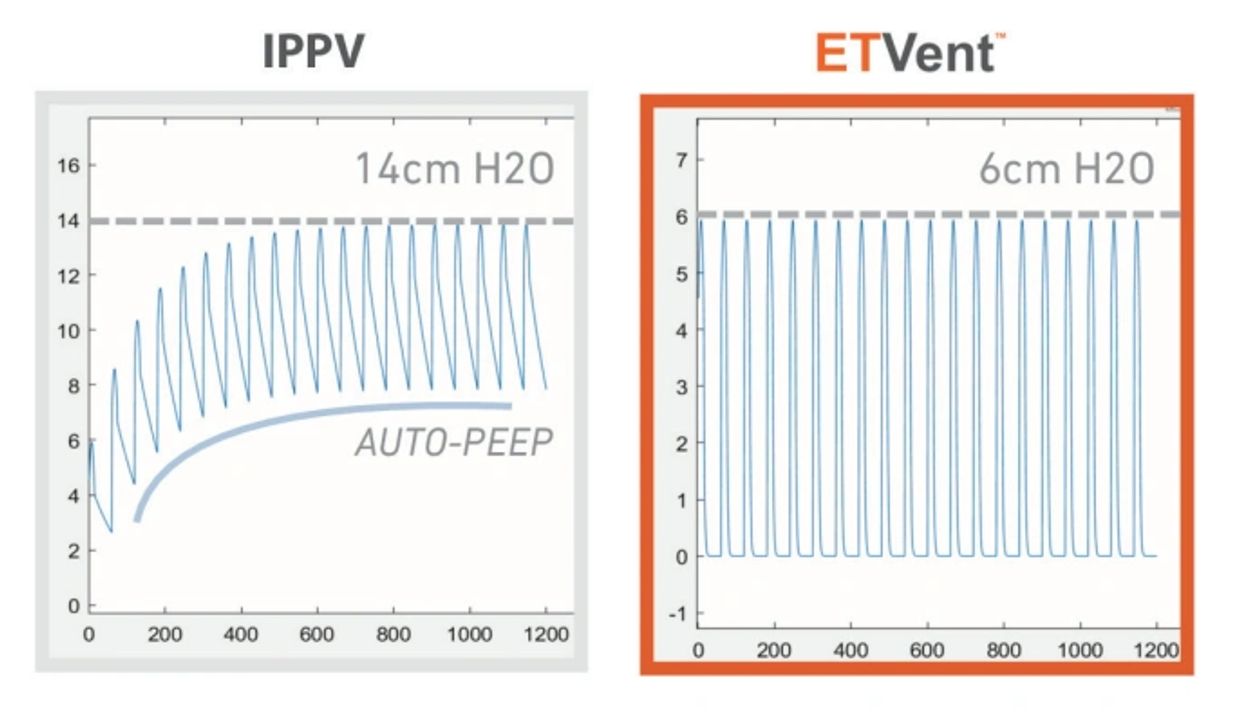
Detailed comparison showing intra-tracheal pressure during CPR for IPPV & ETVent under the same CPR rate of 100 breaths/minute.
ETVent keeps the intra-tracheal pressure at a minimum across time.
Intra-tracheal pressure with ETVent (top-left) falls very quickly, keeping mean lung pressure low. With IPPV (bottom-left), there is slow decay of pressure during exhalation is observed.
In CPR-mode, ETVent (top-right) shows no built-up pressure, as opposed to IPPV (bottom-right).

ETVENT DEMONSTRATION VIDEO
ETVent at Medica Exhibition 2026
ETVent protopyte
PRE-CLINICAL ANIMAL STUDIES
Open chest view of a swine after 5 hours of ETVent intubation.
The edges of the lung (arrow) are sharp, indicating lack of oedema.
Note, there are no signs of atelectasis or hemorrhage.

PRE-CLINICAL ANIMAL STUDIES
Left: Trachea of a piglet with yellow arrow indicating the area where the ETVent cuff was inflating and deflating with each breath for 5 hours at 15 breaths per minute.
Right: Trachea from a control piglet that was ventilated with conventional IPPV for approximately the same duration.

Contact Us
Et Vent
Site Content
RAPID PRESSURE DROP - NO INTRA-TRACHEAL PRESSURE
With common ventilators (IPPV), the air flows in more rapidly than out, resulting in a built-up of pressure.
With ETVent, due to the cuff design, the pressure remains low and stable.

This website uses cookies.
We use cookies to analyze website traffic and optimize your website experience. By accepting our use of cookies, your data will be aggregated with all other user data.